Why AI Is Rewriting the Rules of Cybersecurity for Small Businesses

AI is transforming cybersecurity for small businesses on both sides: attackers now craft convincing phishing, deepfakes, and scaled vulnerability scans, while defenses like anomaly detection and threat monitoring are more accessible than ever. Businesses need practical audits, proportionate defenses, and incident response plans, not enterprise tools, to stay protected and recover quickly.

A security operations room with large network and threat dashboards

Why AI Is Rewriting the Rules of Cybersecurity for Small Businesses

For years, cybersecurity advice for small businesses followed a simple script: use strong passwords, keep software updated, train your team to spot phishing emails. That advice still matters. But artificial intelligence has changed the game on both sides of the fight, and most small businesses have not caught up yet.

The threat side has gotten faster

Attackers now use AI to write phishing emails that no longer read like they were translated badly from another language. They use it to scan for vulnerable systems at a scale no human team could match, and to generate convincing fake voices and videos for scams that used to be easy to spot. A small business that could once rely on “if it looks suspicious, it probably is” no longer has that luxury. The suspicious ones are getting harder to tell apart from the real thing.

The defense side has gotten more accessible

The good news is that AI has also lowered the cost of good defense. Tools that once required a dedicated security team, like anomaly detection, automated log monitoring, and real time threat scanning, are now available to businesses far smaller than the ones that used to be able to afford them. The gap between what a large enterprise can defend against and what a ten person startup can defend against is smaller than it has ever been.

What this actually means for you

Most small businesses do not need a full internal security team. What they need is:

  • A clear-eyed audit of where their actual risk sits (customer data, payment systems, internal tools)
  • Practical, proportionate defenses, not enterprise tools they will never fully use
  • A plan for what happens in the first hour after something goes wrong, because something eventually will

That is a different conversation than “buy antivirus software and hope for the best.” It is closer to how larger companies think about risk, just scaled to fit a business that cannot justify a seven figure security budget.

Where Brenvard fits in

This is exactly the gap our Cybersecurity and Data Protection practice is built for: practical security audits, GDPR and data protection compliance, and incident response planning that fits a growing business rather than an enterprise. Not because you need to be paranoid, but because the businesses that plan for this calmly, before anything happens, are the ones that recover fastest when it does.

If you are not sure where your business actually stands, that is usually the right place to start a conversation.

← Back to insights & news

Related services

Put the thinking
into practice.

More from Insights & News

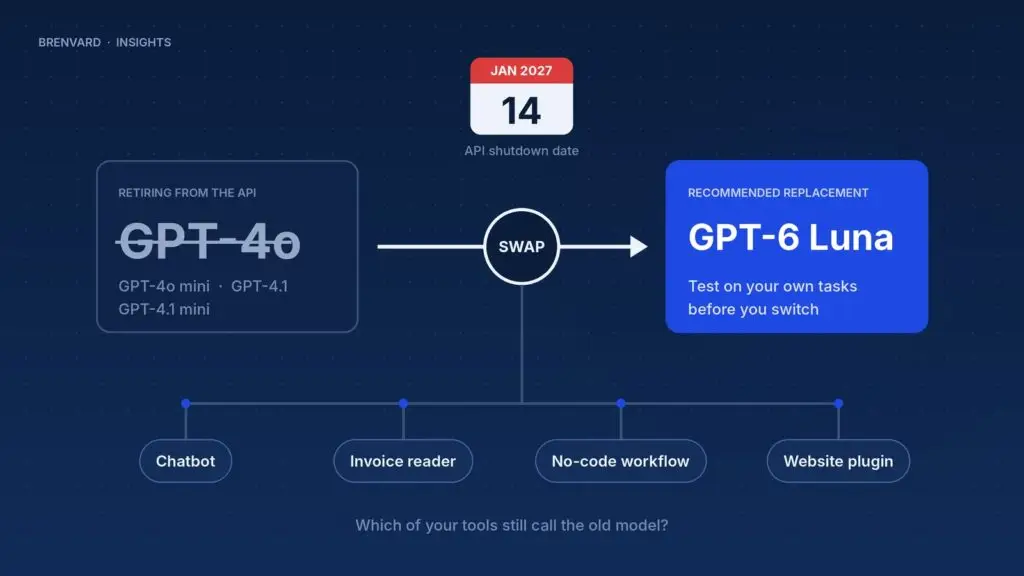
Illustration of the GPT-4o retirement: GPT-4o swapped for GPT-6 Luna before the 14 January 2027 API shutdown

October 20, 2026

GPT-4o Retirement: What Small Businesses Should Do Before January

OpenAI will remove GPT-4o, GPT-4o mini, GPT-4.1 and GPT-4.1 mini from its API on 14 January 2027. Here is why tools built on them may stop working, and how small businesses can

Read article
An adviser reviewing reports and dashboards at a calm desk

October 6, 2026

Copilot Usage-Based Billing: How Small Firms Can Control AI Costs

From 1 December 2026, Microsoft will switch on usage-based billing by default for new Microsoft 365 Copilot Business licences sold through partners. Here is what it means for small businesses and how

Read article
Two professionals reviewing security requirements, documents and hardware prototypes

October 1, 2026

Cyber Resilience Act Reporting Is Now Live: What Small Makers Must Do

Since 11 September 2026, manufacturers of connected hardware and software must report actively exploited vulnerabilities and severe incidents to EU authorities within 24 hours. Here is what the new duty means for

Read article

What’s next
for your business?

Tell us what you are working towards. We will help you find a practical place to start.

Book a conversation