
GPT-4o Retirement: What Small Businesses Should Do Before January
OpenAI will remove GPT-4o, GPT-4o mini, GPT-4.1 and GPT-4.1 mini from its API on 14 January 2027. Here is why tools built on them may stop working, and how small businesses can map, test and migrate in time.
What happened
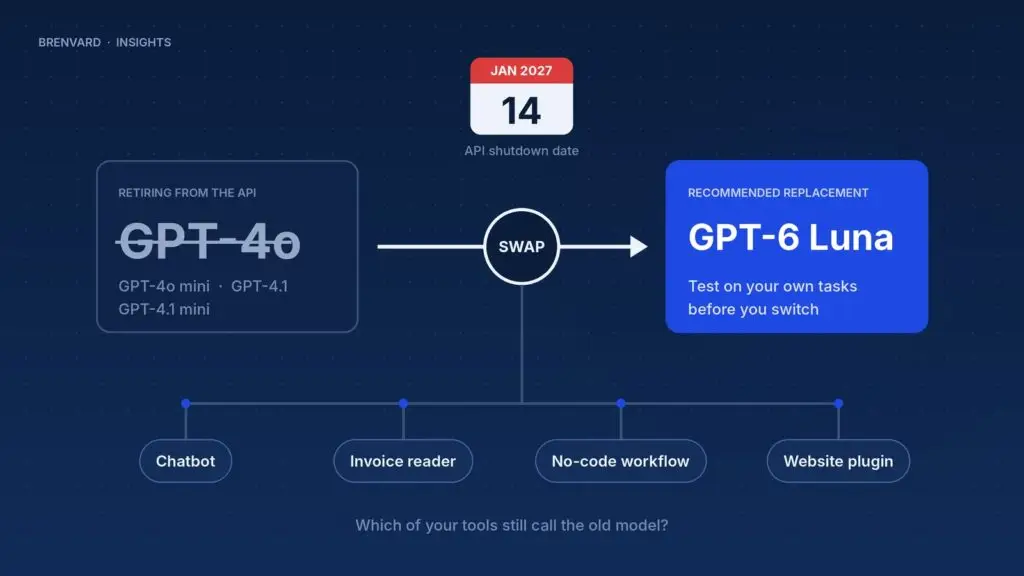
OpenAI has started the GPT-4o retirement in its API. On 14 October 2026, the company notified developers that GPT-4o, GPT-4o mini, GPT-4.1 and GPT-4.1 mini will be removed from the API on 14 January 2027. The notice covers the specific dated versions that many applications call directly, and fine-tuned versions of these models follow the same shutdown schedule as their base models. OpenAI recommends one replacement for all four: GPT-6 Luna.
That gives users 92 days. As Mixed News noted on 19 October 2026, this is shorter than OpenAI's own published policy of at least six months' notice for generally available models. The policy allows faster timelines where safety or compliance requires it, but the report says OpenAI has not cited such a reason here.
Businesses that use the same models through Microsoft are on a different clock. Microsoft's Azure retirement schedule lists 14 April 2027 for these GPT-4o and GPT-4.1 versions, with GPT-5.1 suggested as the replacement for GPT-4o. The change concerns the API, which developers and software vendors use to build AI into products and workflows, not everyday chatting in an app.
Why the GPT-4o retirement matters for a small business
Many smaller businesses never call OpenAI directly. They use GPT-4o through something else: a customer-service chatbot, a tool that reads invoices or emails, a no-code workflow, a website plugin, or a script a freelancer wrote two years ago. When the model behind that tool is switched off, the automation may simply stop working, sometimes with an error message nobody is watching. The risk sits less in the AI itself and more in not knowing where it is used.
There is also an upside. OpenAI lists GPT-6 Luna at $0.10 per million input tokens and $0.50 per million output tokens, describes it as its "most efficient model for focused, high-volume tasks" and gives it a context window of about 1.05 million tokens. GPT-4o, by comparison, is listed at $2.50 and $10, according to DataNorth. A lower list price does not automatically mean a lower bill or a better result, though. OpenAI's migration guide stresses that token usage and reasoning settings affect the cost of each task, so the real cost has to be measured on your own workloads.
Two further points deserve attention. First, OpenAI's model page states that GPT-6 Luna does not support fine-tuning, so a business that relies on a fine-tuned GPT-4o or GPT-4.1 model needs a different approach, such as clearer instructions, examples in the prompt or retrieval from its own documents. Second, changing the model behind a process that touches customers or personal data is also a governance question. Answers may change in tone, format or accuracy, and that should be checked before customers notice.
Practical next steps
1. Map where the models are used. Search code, automation workflows and tool settings for model names such as gpt-4o and gpt-4.1. Include software you pay for: ask each vendor which model their product uses, and when and how they will move before 14 January 2027.
2. Record a baseline. OpenAI's migration guide recommends recording the current model's quality, latency and cost on representative requests, including edge cases. Without a baseline, it is hard to tell whether the replacement is better or worse.
3. Test the replacement carefully. The guide suggests starting GPT-6 Luna with reasoning effort set to "none", checking output formatting and tool use against the baseline, and only then adjusting prompts and settings.
4. Roll out gradually. Send a limited share of real traffic to the new model first and monitor quality, errors and cost before switching fully. If you run on Azure, check Microsoft's dates and suggested replacements separately.
5. Reduce lock-in. Store the model name as a setting rather than hard-coding it, and consider whether a model from another provider fits some tasks better. This makes the next retirement, and there will be one, a configuration change rather than a rebuild.
6. Plan around the calendar. The deadline falls just after the holiday period, when many teams are thin. Finishing testing well before Christmas is the safer choice. Mapping AI dependencies and reworking fragile workflows is the kind of task covered by Brenvard's AI automation and agents work, while broader questions about integrations and vendors sit within Technology & Digital.
Brenvard's perspective
For Brenvard, this notice is a reminder that an AI feature is not a one-off build but a dependency that needs maintenance. As a company that builds websites, web apps and apps and advises startups and smaller businesses on automation, we will have to treat model lifecycles as part of delivery: knowing which model each solution relies on, keeping model names configurable and setting aside time for retesting when a provider changes course. That is extra work, and some of it is hard to predict or price in advance. We also need to apply the same check to any AI tools we use ourselves. The upside is real: newer models can be cheaper and more capable, and a forced migration is a chance to clean up fragile set-ups. Our view is that 92 days is short but manageable for businesses that start now rather than in January, and that every AI integration should be designed so the model can be swapped without rebuilding the process around it.
The bottom line
The GPT-4o retirement is not a crisis, but it is a firm deadline with real consequences for anyone whose tools quietly depend on these models. Find out where they are used, test the replacement on your own tasks and move in steps. Where contracts, customer data or regulated processes are involved, get advice for your own situation before changing what your systems do.
Sources
OpenAI: Deprecations (entry dated 14 October 2026)
OpenAI: GPT-6 Luna model page
OpenAI Help Center: Migrating from GPT-4.x to GPT-6 Luna
Microsoft Learn: Azure OpenAI model retirement schedule
Mixed News: GPT-4o leaves the API on 14 January (19 October 2026)
DataNorth: OpenAI retires GPT-4o and GPT-4.1 in the API
Related services
Put the thinking
into practice.
Explore the services behind our insights, or talk to us about what the article means for your business.
More from Insights & News


What’s next
for your business?
Tell us what you are working towards. We will help you find a practical place to start.